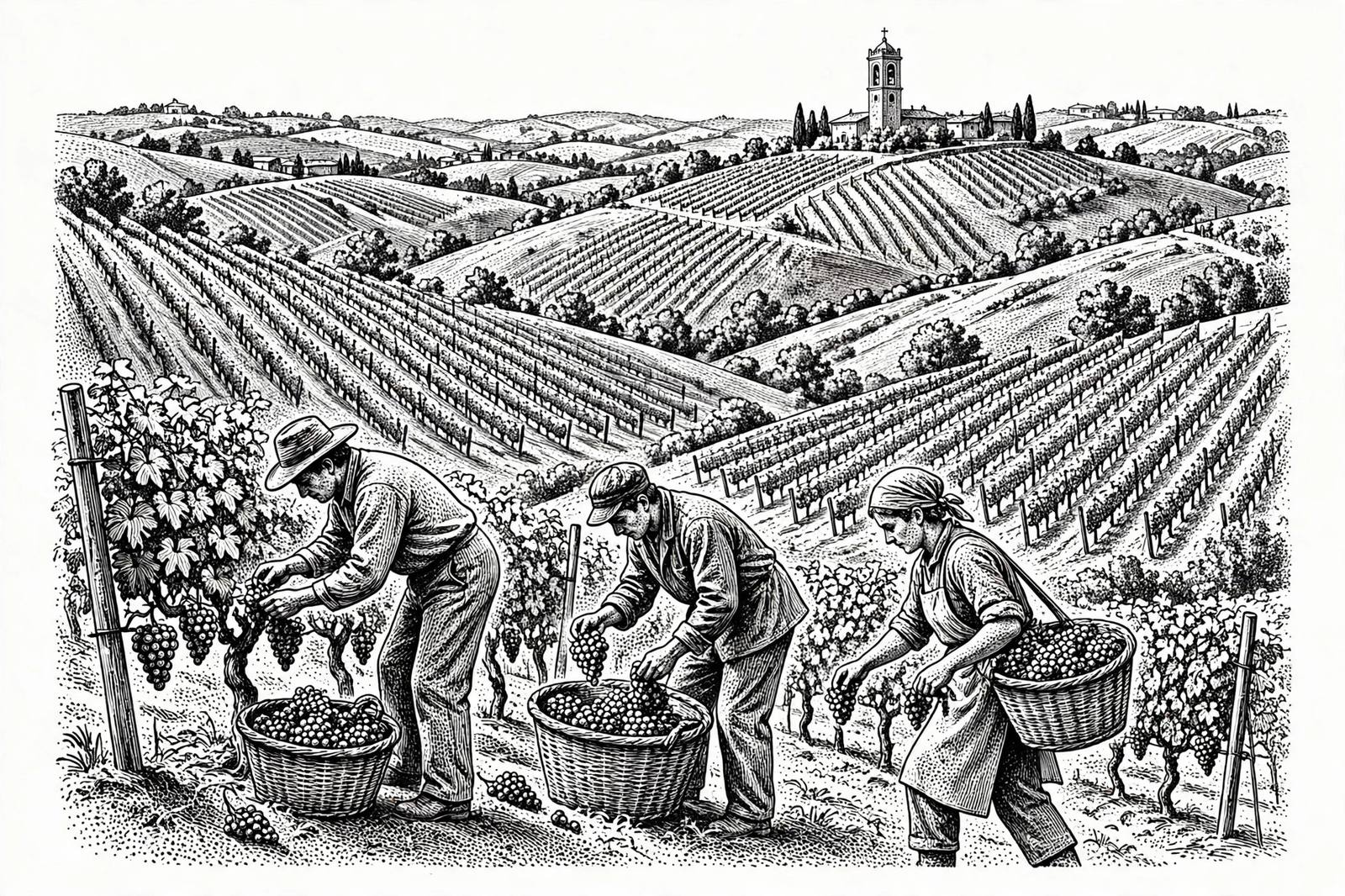
Facing cellars holding roughly 49.1 million hectolitres of stock, more than an average annual harvest, Italy's consortia moved aggressively to cap yields before a grape was picked.
Italy's 2026 harvest opened about ten days early in Oltrepo Pavese with the first sparkling white grapes, a historic start for Lombardy's largest wine area, where picking traditionally begins in early August. Heat accelerated maturation across the peninsula, and while drought leaves the final yields uncertain, quality expectations are cautiously optimistic after a season that largely avoided the peronospora pressure of wetter years.
The early start is the headline, but the structural story is discipline. Facing cellars holding roughly 49.1 million hectolitres of stock as of May 31, 2026, more than an average annual harvest according to the Ministry of Agriculture, Italy's consortia moved aggressively to cap yields before a grape was picked.
Consortia cut deep
The yield cuts are sweeping. Toscana IGT reduced maximum yields by 20 percent, to 13,600 kg per hectare for whites from 17,000 and 12,000 kg for reds from 16,000. Brunello di Montalcino cut from 8,000 to 7,000 kg per hectare. Chianti requested a 20 percent reduction, and Chianti Classico moved from 7,500 to 6,500 kg per hectare. Valpolicella capped yields at 10,000 kg per hectare for the 2025 through 2027 vintages, down from 12,000.
In the northeast, Pinot Grigio delle Venezie set its ceiling at 16,000 kg per hectare with 3,000 kg callable, and Soave DOC effectively halved its production area for three vintages, with caps of 13,000 and 12,000 kg per hectare. The message from the consortia is uniform: with full cellars and soft export markets, volume is the enemy.
Hail, heat and the export overhang
The season was not without damage. Hail struck parts of the Center-North, and the campaign, expected to run about five months, unfolded against a backdrop of rising production costs, labor shortages and declining exports amid U.S. tariffs. High sugar concentration in the early-ripening grapes is a quality positive for many styles but a watch item for balance in the warmest zones.
The export context is the shadow over the vintage. Italian wine exports fell 6.2 percent in value in the first half of 2026, with the United States down 14.1 percent, and the twelve months through July marked the weakest U.S. performance in a decade. A large, high-quality 2026 crop would be welcome in the cellar and a problem in the market.
The regional split
The early-ripening south and the sparkling-wine zones of Lombardy moved first, while the later-ripening reds of Piedmont and Tuscany followed on a more traditional calendar, compressed by heat. That split favors aromatic whites and early-drinking styles in 2026, while producers of long-aging reds face the vintage's central question: whether concentration came with balance, or at its expense.
For buyers, the vintage offers a clear narrative: smaller volumes, deliberate yield restraint and a quality-first posture from the consortia. In a market hungry for stories that justify premium pricing, 2026 gives Italian producers one worth telling.
What the trade should watch
The consortia cuts are doing the market's work in advance: if the early quality signals hold, 2026 could deliver concentrated, age-worthy wines in restrained volumes, exactly the profile that performs in a premiumizing market. The risk is weather in the final stretch and the persistent question of where the wine goes. With American buyers de-stocking and tariffs still in force, Italy's 2026 vintage will need new markets as much as it needs good weather.