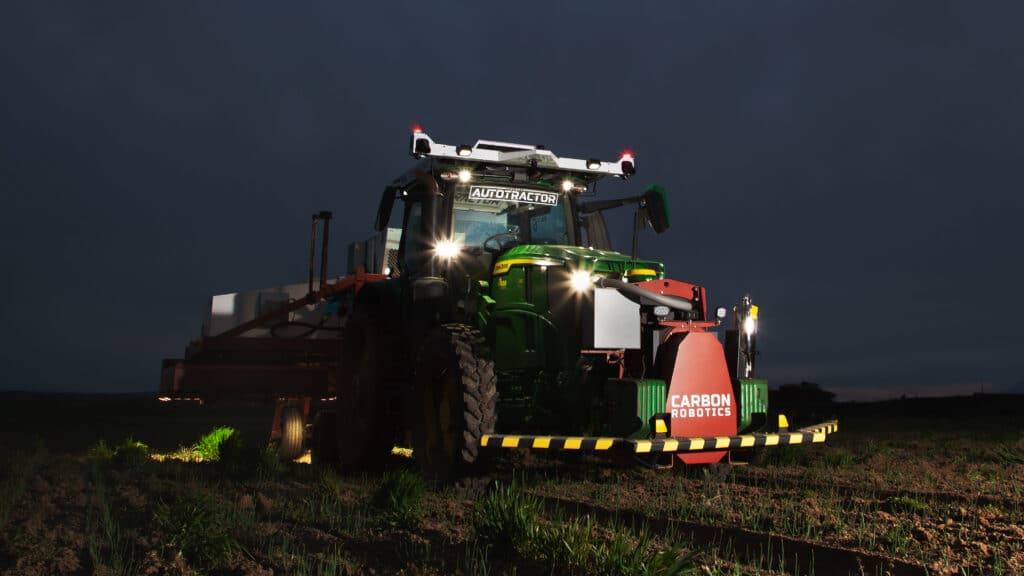
"Autonomous farming implements will help farmers be more efficient and lower costs by extending working hours, solving skilled operator shortages, and increasing tractor utilization."
Carbon Robotics has launched Carbon Autonomy Ready, a program that opens its autonomous tractor platform to outside implement manufacturers, with Great Plains Manufacturing joining as the first member. The program was announced September 1, 2026 and demonstrated the following week at the Farm Progress Show in Boone, Iowa, where a Great Plains HT1100 Terra-Max tillage tool ran autonomously under the Carbon system.
The idea is to stop autonomy from being a closed, single-vendor stack. Carbon Autonomy Ready sets out a technical specification that lets implement makers build their equipment to work with Carbon's autonomous tractors without Carbon engineering each integration itself. Until now, the tractor could run driverless, but towed or mounted implements, tillage tools, planters, sprayers, generally still needed a human in the cab to monitor and adjust settings, or ran on pre-programmed static settings that could not respond to changing field conditions.
Great Plains brings its Implement Command system to the partnership. The integrated solution reads and adjusts implement settings on the fly, depth, down pressure and leveling, the same way an operator would if physically in the cab, using real-time data from the implement itself.
What the company says
"We believe the Carbon Autonomy platform can transform the ways that modern farmers work their fields, and Great Plains is the perfect first partner to launch this program," said Paul Mikesell, founder and CEO of Carbon Robotics. "Our belief is that autonomous farming implements will help farmers be more efficient and lower costs by extending working hours, solving skilled operator shortages, and increasing tractor utilization."
The company frames the program as open to any implement manufacturer, so farmers can choose the equipment that suits their operation without giving up autonomy. Carbon says the specifications are designed to extend beyond tillage to planting and spraying, though the company has not disclosed other partners or a commercial timeline.
Why it matters
Carbon Robotics built its business on the LaserWeeder, a machine that uses computer vision and lasers to kill weeds without herbicide, and more recently on Carbon Autonomy, a kit that converts existing tractors into driverless units. The company has now passed $100 million in annual revenue for its fiscal year ending January 31, 2026, according to roboticsandautomationnews, a milestone that puts it among the few ag robotics firms with real scale.
For vineyards, the direct application is limited today: the demonstration hardware is large-acre tillage, not narrow-row viticulture. But the model is the signal. An open implement standard is the difference between autonomy as a demo and autonomy as infrastructure, because growers buy implements for decades and will not rebuy their entire implement shed from one vendor. If Carbon can recruit a critical mass of implement makers to its specification, it becomes a platform rather than a product, and platform owners set the terms for the next decade of field automation.