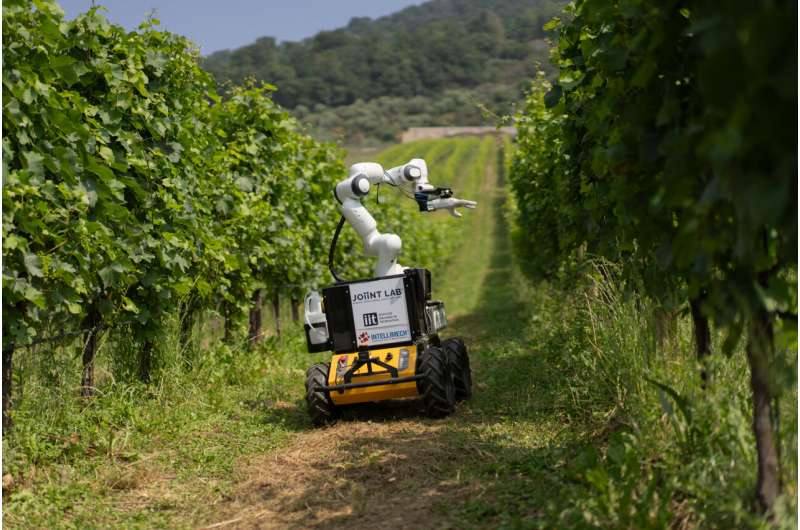
"Integrating robotics and artificial intelligence in agriculture allows us to develop increasingly advanced models of precision farming."
Italian researchers have demonstrated a robot named Frasky that could mark the beginning of vineyard work moving beyond wheeled platforms to manipulation. Developed by the Istituto Italiano di Tecnologia (IIT) in Genoa, Frasky is a cobot-style platform with a robotic arm, designed for tasks that require handling plants and grapes, not just driving between rows. After lab validation, it was field-tested in the "Le Corne" vineyard in Grumello del Monte, in the Bergamo province, where it moved through the rows, mapped its environment and autonomously applied treatments.
The project emerged from JOiiNT LAB, a research-industry collaboration involving IIT, the Consorzio Intellimech, Confindustria Bergamo and the University of Bergamo at the Kilometro Rosso innovation district. The lead research group is the Soft Robotics for Human Cooperation and Rehabilitation Lab led by Manuel G. Catalano, whose expertise in soft and human-interactive robotics points at the hard problem in vineyard automation: interacting physically with delicate, irregular plants without damaging them.
Why an arm matters
Most vineyard robots are mobility platforms: they carry sensors or sprayers down the row. Frasky's arm opens the category of tasks that today can only be done by hand, selective pruning, targeted treatment of individual plants, quality sampling, tasks where the value per vine is highest in premium winegrowing. Manipulation in the field is one of the hardest problems in agricultural robotics because vines are deformable, occluded and different on every plant; soft robotics expertise is directly relevant.
"Integrating robotics and artificial intelligence in agriculture allows us to develop increasingly advanced models of precision farming," said Manuel G. Catalano. Fabio Previdi of the University of Bergamo framed the collaboration model: "Collaboration between research and industry, as in JOiiNT LAB, is key to fostering technological innovation and nurturing new professional skills."
The demonstration was reported on September 18-19, 2025, with coverage noting the platform's ability to navigate the vineyard autonomously and apply treatments without human intervention. This is still research, not a product: no pricing, no commercial availability, no service network. But the trajectory is the story. Europe's public research labs are pushing vineyard robotics past driving and spraying into physical manipulation, and the Bergamo region, home to both the research and the Intellimech industrial consortium, is positioning itself as a hub for it.