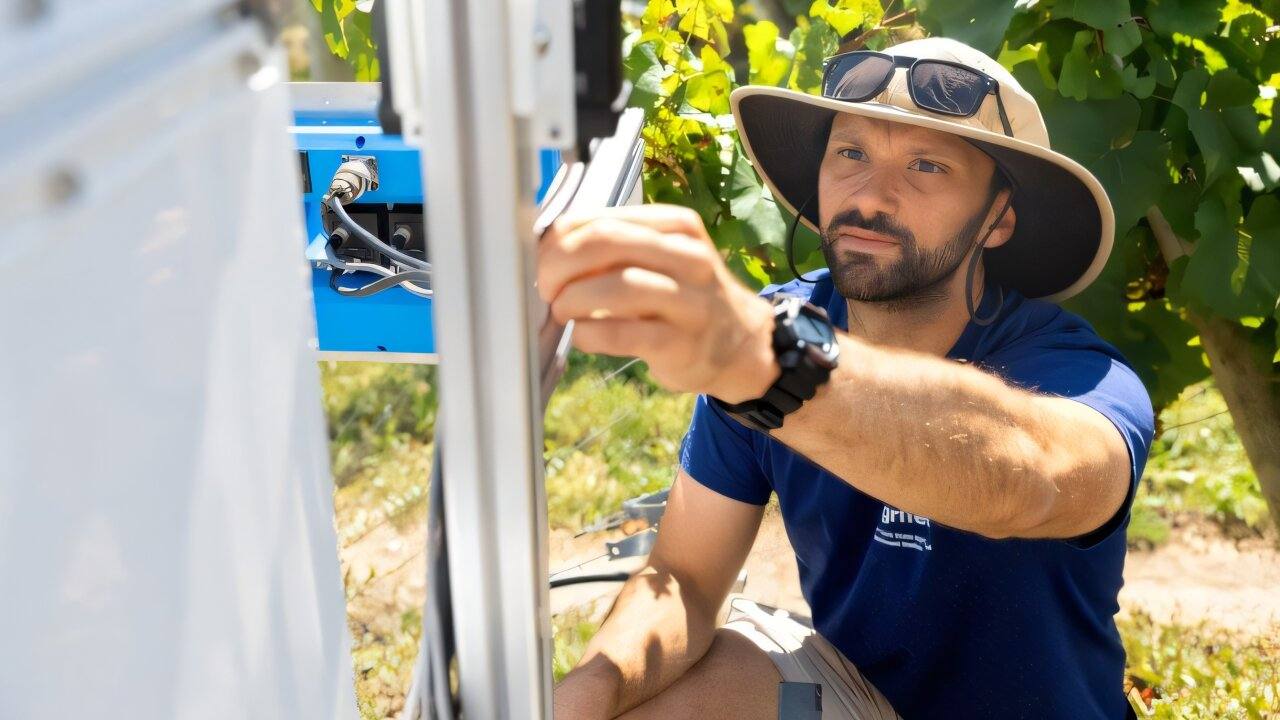
"In the past, I have regularly hired teams of scouts, four or five people, to sweep the vineyards and do the work of one robot."
A Cornell University research team has built an autonomous ground robot that scouts vineyards for disease in near real time, and reports that its accuracy matches highly trained human scouts. The work, published September 8, 2025 in the Journal of Field Robotics (DOI 10.1002/rob.70049), is among the most rigorously tested vineyard robotics papers to date, with trials across ten Cornell pathology vineyards plus commercial vineyards, and additional testing in California, North and South Dakota, Minnesota, New York and West Virginia.
The robot, called PhytoPathoBot, self-navigates trellised rows and takes side-view canopy images. Onboard artificial intelligence segments canopy pixels from disease symptoms, and the system fuses those readings with NASA remote sensing data, GPS and computer modeling to infer spectral disease risk across the block. The result is a near-real-time disease map instead of the slow, labor-intensive scouting sweeps growers rely on today.
Why disease scouting is the killer app
"It is by far ranked as the highest and most potent threat to the sustainability and viability of viticulture in New York, as well as broadly on the East Coast," said Katie Gold, Cornell grape pathologist and the paper's senior author, describing disease pressure. The labor economics are stark: "In the past, I have regularly hired teams of scouts, four or five people, to sweep the vineyards and do the work of one robot."
The payoff is not just labor savings but chemistry. "By having an accurate way of knowing where disease is popping up, we could mostly rely on gentler chemicals and only go with the heavy hitters when absolutely necessary," Gold said. That is the precision-spraying logic the whole industry is chasing: spray less, spray smarter, document everything.
"Disease scouting is not something that just anyone can do, but now our robot will be able to identify those critical stresses for our food systems," said Yu Jiang, the Cornell applied roboticist on the project. "That's been a motivation for us: how can we use robots to do this very skilled job?"
From paper to product
The commercial path is already in motion: first author Ertai Liu, a postdoctoral researcher at Cornell AgriTech in Geneva, has co-founded a California startup to commercialize the technology. That matters because peer-reviewed vineyard robotics rarely makes the jump from publication to product, and a startup vehicle with the research team behind it is the most credible commercialization signal this field produces.
The caveats are the usual ones for academic robotics: matching human scouts in controlled trials is not the same as matching them across a wet, chaotic commercial season, and pricing, service and integration with spray equipment are all unanswered. But the combination of multi-state field testing, a published accuracy claim and a commercialization startup makes PhytoPathoBot one of the vineyard autonomy stories most worth tracking into 2027.