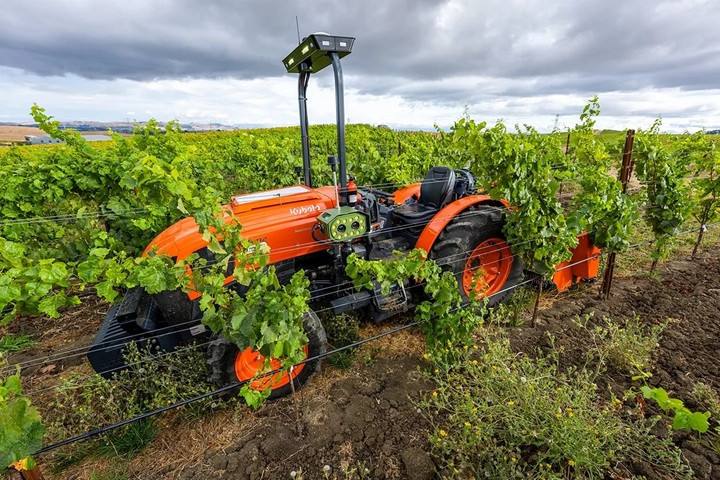
"One operator can easily manage three machines."
Kubota used CES 2026 in Las Vegas to announce the commercialization of a factory-integrated autonomous solution for its M5 Narrow specialty tractor, developed in partnership with US startup Agtonomy and built directly into the 105.7-horsepower diesel platform. The move positions the M5 Narrow, a tractor sized for orchards and vineyards, as one of the first autonomous specialty tractors sold by a major equipment maker rather than a startup.
The reference customer is in wine. Treasury Wine Estates is operating four autonomous M5 Narrow units in North Napa Valley this year, using them for mowing and under-vine cultivation. "We put Kubota's M5 Narrow tractor to work during mowing and under-vine cultivation," said Marc Di Pietra, regional service maintenance manager for Treasury Wine Estates. "It handles routine passes with autonomy and sensing across every row and block, which reduces rework, increases efficiency, and gives our team more time to focus on what matters most."
Di Pietra, who spoke at length with DTN/Progressive Farmer about the deployment, reported that Treasury Wine Estates has increased autonomous spraying coverage five times over the last two years, and that "one operator can easily manage three machines." The challenges he flagged are practical and vineyard-specific: headland and row spacing, rocks under the vines, and three-point turns in tight rows.
What Kubota is selling
Unlike retrofit autonomy kits, Kubota's system is factory-integrated into the tractor with advanced sensing and artificial intelligence, intended to automate crop growth sensing and chemical spraying alongside routine passes. "Physical AI is a key inflection point for our industry and for Kubota," said Brett McMickell, chief technology officer for Kubota North America. "Decision-making, obstacle detection and voice recognition capabilities mean AI real-time insights will now inform tasking, labor assignments, and efficiency improvements." Todd Stucke, president of Kubota North America, framed the strategy as customer-driven: "Our go-to-market solutions are the culmination of our customer-driven innovation cycle, where the goal is not simply to automate what you've always done, but to rethink how work can be done more intuitively and efficiently."
Pricing and commercial availability were not announced, Future Farming reports. Kubota also showed a concept "transformer" platform robot (KVPR) that expands, contracts and moves along every axis, but the KVPR is a concept, not a product.
Why it matters for vineyards
The economics Di Pietra describes are the ones that decide vineyard automation: one operator running three machines on routine passes, with sensing on every row reducing rework. If Kubota can deliver that through its dealer network with factory integration, the adoption barrier falls well below what startups have achieved, because the machine is bought and serviced like a normal tractor.
The open questions are the ones Kubota did not answer at CES: price, availability timeline, and how the autonomy handles the edge cases every vineyard manager knows, slopes, odd row ends and sensor failures in dust. The North Napa deployment is the proof point to watch. If four units run a full season of mowing and under-vine work with one operator supervising three machines, the labor math for large vineyard operations changes permanently.