"The new herbicide capability addresses a real need for growers seeking automation that integrates seamlessly into existing programs, particularly where labour availability and timing are a challenge."
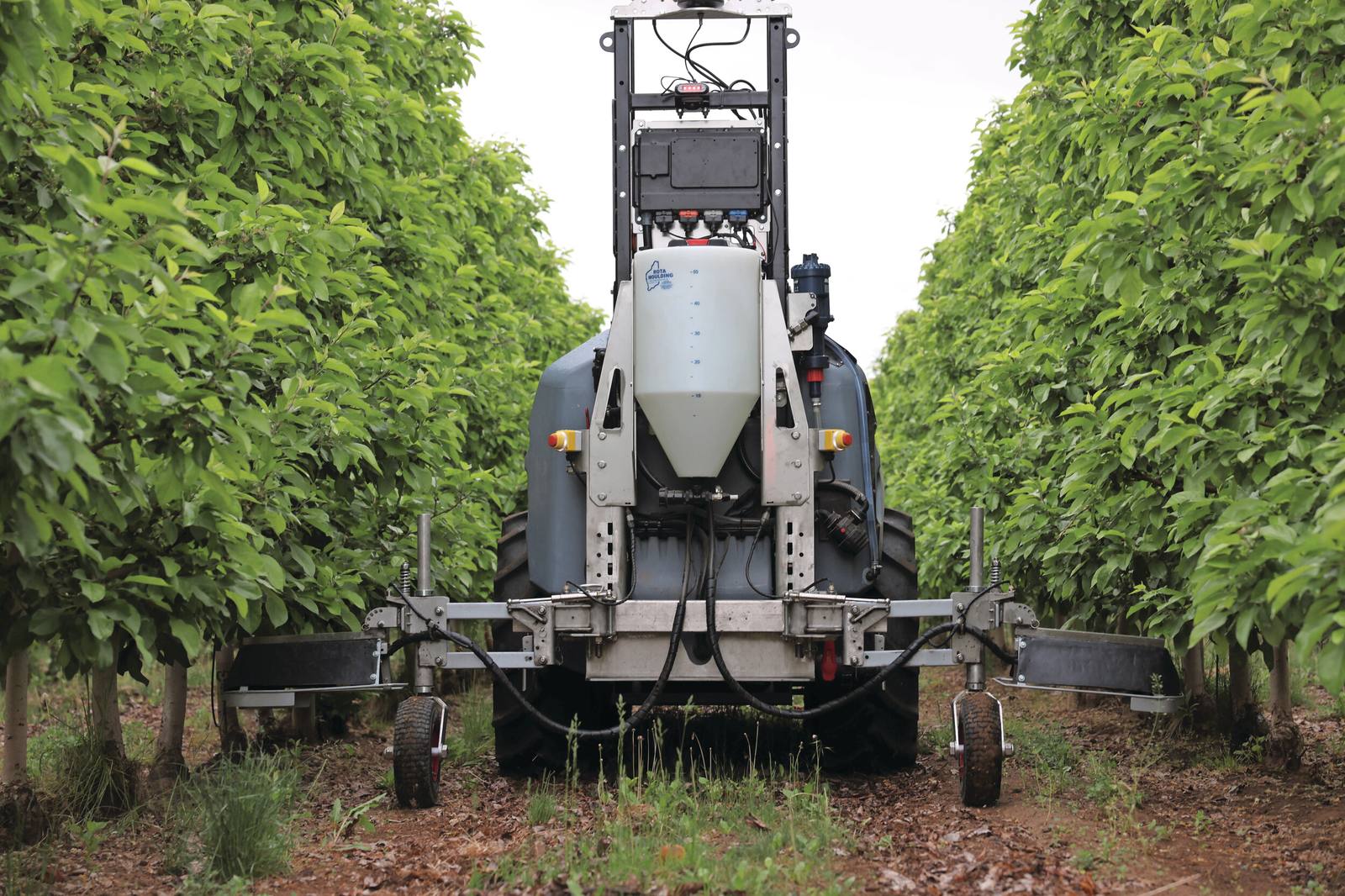
Yamaha Agriculture has added herbicide spraying to its Prospr autonomous hybrid vehicle platform with a new attachment developed and manufactured with Croplands Equipment. Announced May 27, 2026 from Palo Alto, the attachment brings automated weed control to the modular vehicle already working in orchards and vineyards across the United States, Australia and New Zealand. It made its public debut at Hort Connections 2026 in South Australia.
The attachment slots into Prospr's modular architecture, letting growers switch between tools without significant downtime. The system automates nozzle activation, tank agitation, liquid level monitoring and spray rate adjustments in real time based on vehicle speed, with mechanical breakaway boom arms designed to protect crops, vines and equipment during close-quarters work. Growers can choose direct tank mixing or inline dosing for chemical management, and all configurations connect to Yamaha Agriculture's multi-vehicle remote (MVR) interface, which allows one or two operators to monitor and manage a fleet of Prospr vehicles simultaneously.
Why weed control, why now
"Prospr was built to perform today and for the future. It is modular, AI-powered and can accommodate attachments made by our partners for a range of tasks," said Yamaha Agriculture president and CEO Nolan Paul. "The new herbicide attachment highlights the platform's flexibility to seamlessly support multiple applications across vineyards and orchards throughout the growing cycle." Paul added that "the new herbicide capability addresses a real need for growers seeking automation that integrates seamlessly into existing programs, particularly where labour availability and timing are a challenge, such as weed control which impacts the quality and performance of the grown crop."
Weed management in vineyards is timing-critical: delays directly affect crop quality and yield, and labor availability is increasingly the constraint. Automating the under-vine pass turns one of the most labor-sensitive jobs in the vineyard into a fleet operation supervised by a single operator.
The platform play
Yamaha Agriculture, which acquired Robotics Plus and rebranded the Prospr platform under its own name, is pursuing a deliberately open model: the hybrid diesel-electric vehicle is the base, and partner-built attachments, like Croplands' herbicide system, extend it across the season. The company claims the hybrid system can operate for up to 40 hours and reduce fuel consumption compared with conventional equipment, both vendor claims pending independent verification.
The business implication for vineyards is that automation is arriving as a platform ecosystem, not a single machine. Growers who buy into Prospr are buying the ability to add weed control, spraying and other tools to the same autonomous base. The question for winery operations teams is the same one autonomy always raises: service, parts and software support over a ten-year equipment life. Yamaha's scale answers that question more convincingly than a startup could.